Court Rules Alina Habba Unlawfully Serving As NJ Prosecutor
Appeals Court Rules Trump-Appointed Attorney Alina Habba Unlawfully Serving As NJ Prosecutor

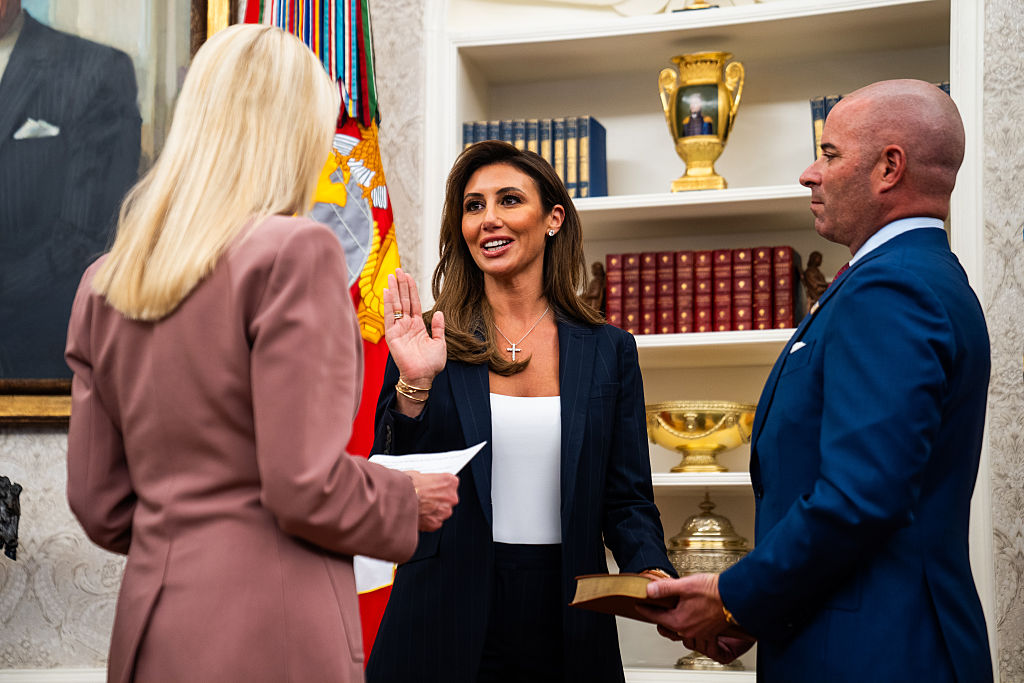
A federal appeals court ruled that Alina Habba, former personal attorney to Donald Trump, has been unlawfully serving as the top federal prosecutor in New Jersey—marking it one of the most consequential legal rebukes against the administration’s efforts to sidestep Senate confirmation requirements and embed political loyalists in high-ranking Justice Department roles.
The unanimous decision, handed down on Monday by a three-judge panel of the U.S. Court of Appeals for the Third Circuit, affirmed an August ruling by U.S. District Judge Matthew Brann that Habba’s continued service violated the Federal Vacancies Reform Act (FVRA). In the 32-page opinion, the court determined that the administration deployed a “novel mechanism” designed explicitly to evade statutory time limits and constitutional checks requiring Senate approval.


“It is apparent that the current administration has been frustrated by some of the legal and political barriers to getting its appointees in place,” Circuit Judge D. Michael Fisher wrote in the appellate ruling.
“The unusual series of legal moves taken by the Department of Justice to install Habba, one of Trump’s former personal lawyers, as an acting U.S. attorney demonstrates the difficulties it has faced. Yet the citizens of New Jersey and the loyal employees in the U.S. Attorney’s Office deserve some clarity and stability.”
The controversy stems from a chain of personnel moves orchestrated by the Justice Department earlier this year. In March, Attorney General Pam Bondi appointed Habba as Interim U.S. Attorney, following the quick resignation of her previous pick. Trump nominated her in June, but she never underwent the Senate confirmation process. When her term expired in July without a Senate-confirmed successor, federal law transferred the power to appoint an interim replacement to New Jersey’s district judges, who selected veteran career prosecutor Desiree Leigh Grace.
But the Trump-aligned Justice Department moved swiftly to undo that lawful appointment. Attorney General Pam Bondi immediately fired Grace, then rehired Habba as a “Special Attorney to the Attorney General” and First Assistant U.S. Attorney. The move was intended to exploit a technical vacancy provision—automatically elevating Habba back to acting U.S. Attorney despite the judges’ selection.
The Third Circuit rejected the maneuver outright, ruling that accepting the administration’s theory would “render the Vacancies Act’s time limits meaningless.” The panel concluded that the political reshuffling amounted to an attempted “usurpation of longstanding statutory processes.”
“Under the Government’s delegation theory, Habba may avoid the gauntlet of presidential appointment and Senate confirmation and serve as the de facto U.S. Attorney indefinitely,” the unanimous panel wrote. “This view is so broad that it bypasses the constitutional (appointment and Senate confirmation) process entirely.”
It concluded: “We will affirm the District Court’s disqualification order.”
The ruling carries immediate and far-reaching implications for the U.S. Attorney’s Office in New Jersey. Habba is now disqualified from exercising the powers of the office, raising potential questions about the validity of indictments, plea agreements, and other prosecutorial actions taken during her unlawful tenure.
As noted by CNBC, lawyers for one of the parties in the case challenging Habba’s appointment, Abbe Lowell and Gerald Krovatin, noted in a statement that the ruling marks “the first time an appellate court has ruled that President Trump cannot usurp longstanding statutory and constitutional processes to insert whomever he wants in these positions.”
“We will continue to challenge President Trump’s unlawful appointments of purported U.S. Attorneys wherever appropriate,” the lawyers said in a joint statement.
Habba, who rose to national prominence as a combative defender of Trump during his New York civil fraud trials, faced criticism from the start due to her inexperience despite being Trump’s pick for the top federal law enforcement position in a major district. Her appointment reinforces the broader second-term Trump strategy to place loyal attorneys in interim roles across the federal government, bypassing a narrowly divided Senate unwilling to confirm many of his nominees.
Monday’s ruling is the first from a federal appeals court to directly confront these appointment maneuvers. Similar challenges are underway in other jurisdictions, including Virginia, where the appointment of Lindsey Halligan—another Trump attorney turned federal prosecutor—has come under intense scrutiny following the dismissal of indictments against former FBI Director James Comey.
As noted by CNN, an attorney for Julien Giraud, Jr., one of the three defendants who challenged Habba’s eligibility, praised the ruling.
“The panel issued a clear and carefully reasoned decision that recognizes the extraordinary power vested in US attorneys and reinforces the limits Congress has set on who may occupy those positions,” said Thomas Mirigliano. “We appreciate the court’s thoughtful approach and the clarity it brings to this important issue.”
Legal experts expect the Trump administration to appeal the Third Circuit’s decision to the U.S. Supreme Court, where a definitive ruling could determine the limits of presidential authority over interim appointments. For now, the decision forces the Justice Department either to nominate a Senate-confirmable candidate or rely on a court-appointed interim U.S. Attorney to restore stability and legality to the New Jersey office.
SEE ALSO:
Newark Mayor Ras Baraka Released After Arrest, Detainment By ICE Officers
Newark Mayor Ras Baraka Sues Over Arrest At ICE Facility
New Jersey Rep. LaMonica McIver Indicted On Assault Charges
Appeals Court Rules Trump-Appointed Attorney Alina Habba Unlawfully Serving As NJ Prosecutor was originally published on newsone.com